
A physiotherapy clinic website should do much more than simply look professional.
For physiotherapy, rehabilitation and chiropractic clinics, the website is often one of the first interactions a prospective patient has with the business.
Within a few seconds, that visitor should be able to understand what your clinic offers, where you are located, whether the clinic appears credible, and what they should do next.
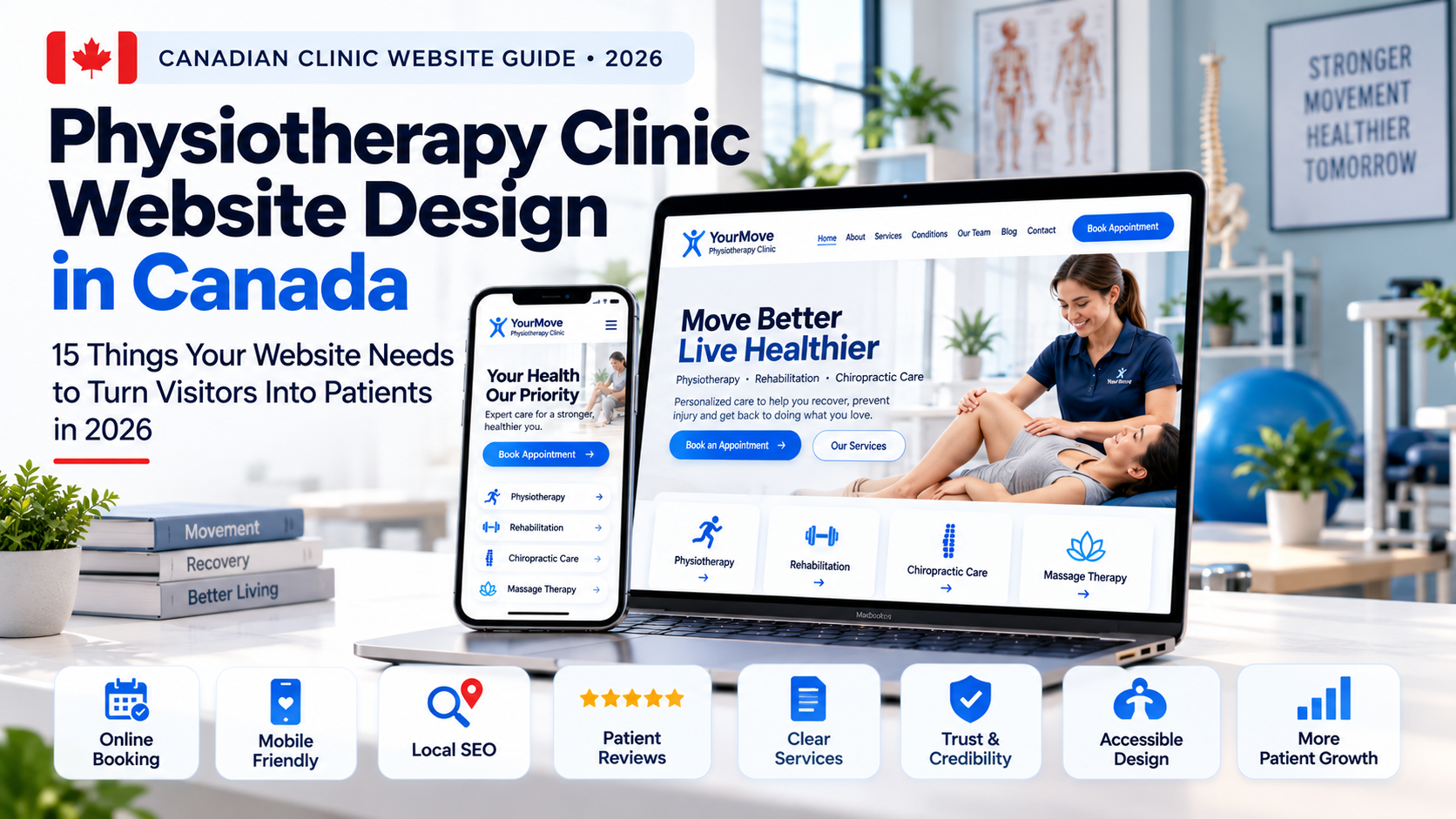
This guide covers 15 practical elements a Canadian clinic website should consider in 2026 to improve patient experience, local visibility, enquiries and appointment-booking opportunities.
What Should a Physiotherapy Clinic Website Actually Accomplish?
A potential patient might arrive on your website from Google Search, your Google Business Profile, social media, a referral or a link sent by someone they trust.
Regardless of where they came from, their questions are usually practical:
- Does this clinic offer the service I need?
- Where is the clinic located?
- Can I book an appointment online?
- Who are the practitioners?
- What should I expect?
- What are the clinic hours?
- Can I ask someone a question before booking?
Your website should make those answers easy to find.
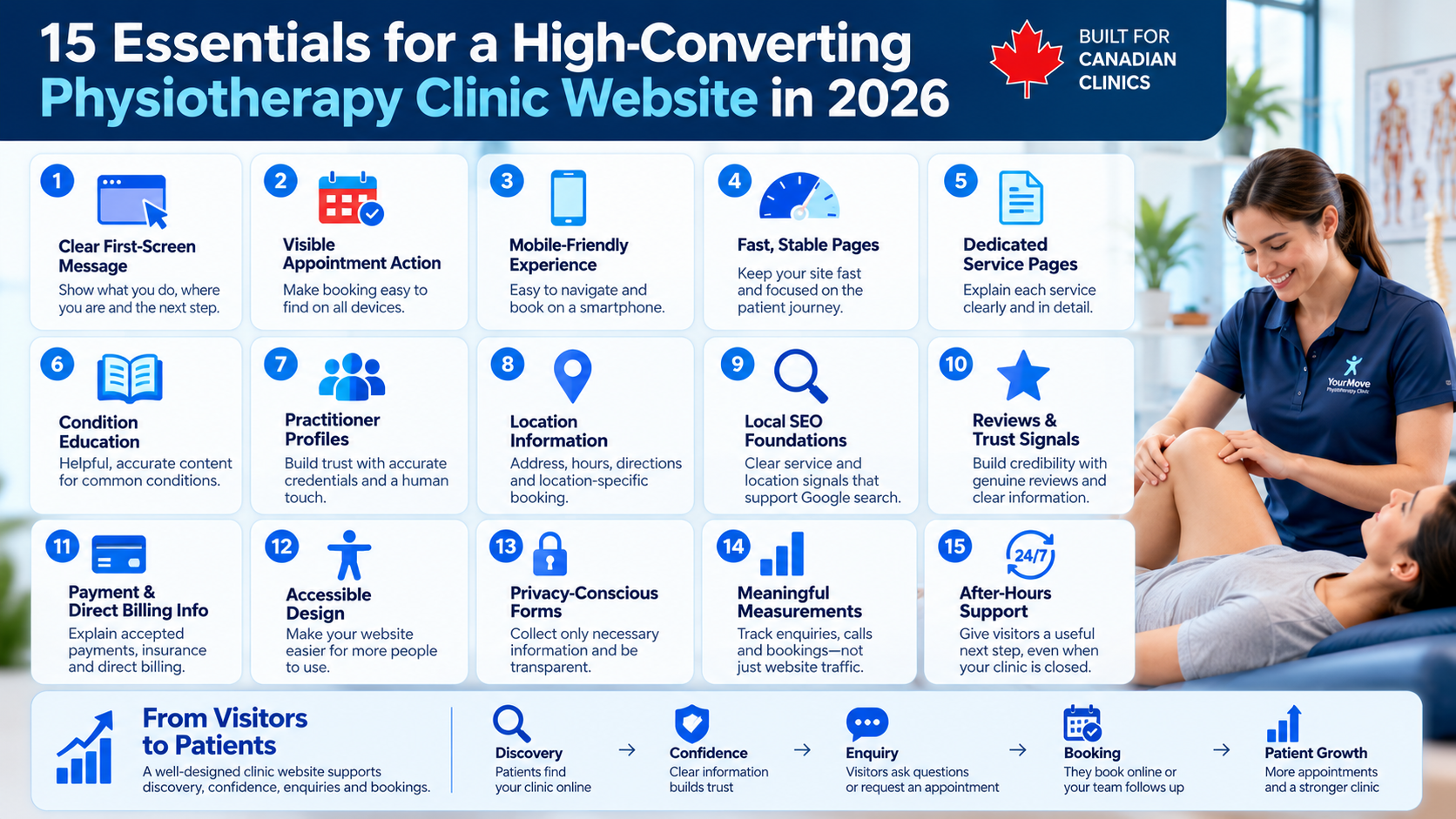
15 Things Your Physiotherapy Clinic Website Needs in 2026
1. A Clear First-Screen Message
The top section of your website is valuable space. A visitor should quickly understand what type of clinic you operate, your primary services, your location or service area, and the main next step.
A generic message such as “Welcome to Our Clinic” says very little. A more useful opening communicates what the clinic actually does and gives the visitor a clear action such as Book an Appointment, Explore Services or Contact the Clinic.
2. A Visible Appointment Action
If appointments are important to your business, booking should not be hidden several clicks inside the website.
Your primary booking action should be easy to locate on both desktop and mobile devices.
If your clinic uses Jane App or another online booking platform, the transition between your website and the booking system should feel intentional and straightforward.
3. A Genuinely Mobile-Friendly Experience
Many prospective patients will discover and evaluate your clinic from a smartphone.
A mobile-friendly clinic website should have readable text, easy-to-tap buttons, simple navigation and forms that do not require constant zooming or horizontal scrolling.
The appointment-booking journey should also be tested on an actual phone—not only on a desktop computer.
4. Fast and Stable Pages
Large images, unnecessary scripts, excessive animations and poorly optimized third-party tools can make a website unnecessarily heavy.
Visual design matters, but it should support the patient journey rather than interfere with it.
Google's documentation explains that Core Web Vitals are used by Google's ranking systems, while also emphasizing that good page experience involves more than achieving individual performance scores.
5. Dedicated Service Pages
If your clinic offers several services, avoid trying to explain everything in one paragraph on the homepage.
Important services can have their own useful pages—for example:
- Physiotherapy
- Chiropractic care
- Rehabilitation
- Massage therapy
- Sports injury rehabilitation
- Concussion rehabilitation
- Pelvic health physiotherapy
- Other clinic-specific services
Each page should explain the service clearly, answer common questions and provide an appropriate next step.
6. Useful Condition-Focused Educational Content
Patients often search for information about a problem before they search for a specific treatment.
Where appropriate, clinics can create educational content addressing common reasons people seek care. However, these pages should educate rather than attempt to diagnose the visitor.
Clinical information and healthcare claims should be reviewed by appropriately qualified clinic professionals.
This also aligns with Google's broader recommendation to create helpful, reliable, people-first content rather than content created primarily to manipulate search rankings.
7. Practitioner Profiles That Build Trust
For many patients, choosing a healthcare provider is personal.
Useful practitioner profiles can include:
- Professional role
- Relevant credentials
- Areas of practice
- Languages spoken
- A professional photograph
- A short human introduction
Keep qualifications and claims accurate and verifiable.
8. Location Information That Is Easy to Find
Do not make patients search through the website just to figure out where the clinic is located.
Useful location information can include:
- Full address
- Clinic hours
- Phone number
- Map or directions
- Parking information where relevant
- Transit information where useful
- Location-specific booking action
If you operate multiple clinics, clearly distinguish between the locations.
9. Strong Local SEO Foundations
A clinic website should clearly communicate what services the business provides and where it provides them.
That includes descriptive service content, useful location information, consistent business details, logical internal links and clear page titles and headings.
Your website and Google Business Profile should reinforce each other rather than present conflicting information.
Clinic owners can also use Google's official guidance on improving local ranking on Google when reviewing the completeness and accuracy of their Business Profile.
10. Reviews and Trust Signals Used Responsibly
Trust plays an important role when someone is choosing a clinic.
Useful trust signals may include practitioner information, professional affiliations where appropriate, clinic photographs, clear policies and genuine reviews.
Healthcare businesses should nevertheless be careful with patient privacy, testimonials and applicable professional advertising requirements.
Never manufacture reviews or promise specific treatment outcomes.
11. Clear Payment, Insurance and Direct-Billing Information
Administrative questions can generate significant front-desk workload.
Where applicable, your website can explain general information about accepted payment methods, insurance and direct billing.
Avoid guaranteeing insurance coverage. Patients may still need to confirm their individual benefits directly with their insurer.
12. Accessible Website Design
Accessibility should be considered during the design process rather than treated as an afterthought.
Useful considerations include:
- Readable colour contrast
- Logical heading structure
- Keyboard-friendly navigation
- Useful image ALT text
- Clearly labelled forms
- Readable font sizes
- Clear error and confirmation messages
For a recognized technical reference, the World Wide Web Consortium publishes the Web Content Accessibility Guidelines (WCAG).
Clinics should also determine whether provincial accessibility requirements apply to their organization. For example, Ontario publishes official guidance on website accessibility requirements under Ontario's accessibility framework.
13. Privacy-Conscious Enquiry Forms
Do not ask prospective patients for unnecessary information simply because a form can collect it.
Health-related information can be particularly sensitive personal information.
Your clinic should understand what information a form collects, why it is being collected, where it is sent, who can access it and how it is retained.
The Office of the Privacy Commissioner of Canada provides official guidance on consent and the collection and handling of personal information.
14. Measurement Beyond Raw Website Traffic
Getting more website visitors can be useful, but traffic by itself does not tell you whether the website is helping your clinic.
Depending on your setup, more useful measurements may include:
- Appointment-booking clicks
- Phone calls
- Submitted enquiries
- Location/directions interactions
- Service-page engagement
- After-hours enquiries
- Other meaningful conversion events
The objective is to understand whether visitors are successfully reaching useful next steps.
15. A Plan for After-Hours Visitors
Your clinic may close at 6 PM. Your website does not.
A potential patient may search for physiotherapy at 9:30 PM, on a Sunday or while your receptionist is already helping someone else.
The visitor should still be able to understand your services, find routine information and take an appropriate next step.
This is where a carefully designed 24/7 AI Patient Enquiry & Booking Assistant can support the patient journey.
What Should a Clinic Website Audit Examine?
A useful website audit should go beyond telling you that your title tag is too long.
Discovery
Can search engines and prospective patients clearly understand your services and locations?
Patient Experience
Can a mobile visitor quickly understand the clinic, navigate the site and reach booking?
Conversion
Are appointment, phone and enquiry actions visible and measurable?
Performance
Are unnecessary scripts, images or third-party tools slowing down important pages?
Local SEO
Are your service and location signals clearly structured?
Trust
Can visitors easily find practitioner, service, clinic and contact information?
Privacy & Accessibility
Are forms, third-party tools and important website interactions being handled thoughtfully?
After-Hours Journey
What happens when someone wants information or an appointment after reception closes?
How Much Should a Physiotherapy Clinic Website Cost?
There is no single correct price for every clinic website.
The appropriate investment depends on factors such as:
- Number of clinic locations
- Number and complexity of services
- Custom versus template-based design
- Content requirements
- Local SEO requirements
- Online booking integrations
- Analytics and conversion tracking
- AI or workflow automation
- Ongoing support requirements
For a broader Canadian pricing framework, read our Small Business Website Cost in Canada 2026 guide.
Where Do AI, CRM, Telecom and Mobile Apps Fit?
Your website can be the digital front door without being the clinic's entire technology stack.
As a business grows, website enquiries may eventually connect with CRM or other operational systems.
Our Odoo for Canadian SMBs guide explains the broader CRM and ERP decision.
If your business is considering dedicated patient-facing software rather than simply improving the mobile website, see our Mobile App Development Cost in Canada guide.
And if telephone calls remain an important source of enquiries, our Business Phone Systems in Canada guide covers the communications infrastructure side.
Where Does a 24/7 AI Patient Assistant Fit?
An AI assistant should not be added simply because AI is popular. There should be a clear operational purpose.
For example, a clinic may want to provide approved answers to routine questions after hours, help visitors locate the appropriate service or location, guide people toward online booking, or capture an enquiry for staff follow-up.
That requires clear boundaries—particularly around medical questions, personal information and situations requiring human judgement.
Read our companion guide:
Frequently Asked Questions
Does Every Physiotherapy Clinic Need a Custom Website?
No. The appropriate approach depends on the clinic's services, number of locations, competitive market, content requirements, integrations and growth plans.
The important question is whether the website supports the clinic's actual patient journey and business requirements.
Should a Physiotherapy Website Integrate With Jane App?
If the clinic uses Jane for online booking, providing a clear path from the clinic website to the appropriate booking experience can reduce friction.
The exact implementation should be based on the clinic's workflow and the technical capabilities available from the booking platform.
Does a Clinic Need Separate Pages for Every Service?
Not necessarily every minor variation.
Important services that patients genuinely search for or need explained usually deserve useful, substantive content of their own.
Avoid creating dozens of nearly identical pages solely to target keyword variations.
Can a Better Website Guarantee More Patients?
No.
A well-designed website can improve discoverability, clarity, usability and conversion opportunities, but patient acquisition depends on many factors including demand, location, competition, reputation, services, marketing and the patient experience itself.
Should a Physiotherapy Clinic Use an AI Chatbot?
It can be useful when there is a clearly defined purpose and appropriate safeguards.
An assistant may help with approved routine enquiries, service navigation and booking guidance, but it should not be positioned as a clinician or used to independently provide diagnosis or treatment recommendations.
Before Redesigning Your Clinic Website
Instead of beginning with colours, animations or page count, start with the patient journey.
- How do prospective patients currently discover the clinic?
- What questions do they ask before booking?
- What information causes confusion?
- Where do visitors abandon the process?
- How easy is booking from a mobile phone?
- What happens after business hours?
- Which repetitive questions consume front-desk time?
- What website actions are currently being measured?
Those answers can help determine what actually needs to change.
Authoritative External References
For further guidance, clinic owners and website teams can consult these primary and authoritative sources:
-
Google Search Central — Creating Helpful, Reliable, People-First Content
Google Search Central guidance -
Google Search Central — Core Web Vitals
Google Core Web Vitals documentation -
Google Business Profile Help — Tips to Improve Your Local Ranking on Google
Google Business Profile guidance -
Office of the Privacy Commissioner of Canada — Consent
Government of Canada privacy guidance -
W3C Web Accessibility Initiative — WCAG
Web Content Accessibility Guidelines -
Government of Ontario — How to Make Websites Accessible
Ontario accessibility guidance
External resources are provided for general reference. Requirements may vary according to province, profession, organization and circumstances.
How Well Is Your Clinic Website Actually Performing?
HiTech Consultancy can review your physiotherapy, rehabilitation or chiropractic website for mobile usability, patient journey, conversion opportunities, SEO foundations and opportunities for enquiry and booking automation.