
For many Canadian small businesses, a website is no longer just an online brochure. It can be the place where a potential customer discovers the company, checks whether it looks trustworthy, compares services, calls, submits a form, books an appointment or starts a purchase.
That is why the question “How much does a website cost in Canada?” cannot be answered responsibly with one number. A five-page informational site, a lead-generation website, an eCommerce store and a customer portal are all called “websites,” but they require very different levels of strategy, design, development, content, integration and testing.
Quick answer
For planning purposes in 2026, Canadian businesses may see everything from low-cost DIY builds to professional small-business projects in the several-thousand-dollar range and custom platforms well above that. Current Canadian agencies publish very different bands, which reinforces the point that scope matters more than page count alone. The useful question is not “What is the cheapest website?” but “What level of website does this business actually need to produce the intended result?”
This guide explains the main pricing models, what drives cost, what should be included in a professional build, what businesses can safely simplify, and how to evaluate website investment in commercial terms rather than design terminology.

How much does a small business website cost in Canada in 2026?
There is no official national price list for website development. Published Canadian pricing guides in 2026 show wide variation. Some position professional small-business sites around the lower-to-mid thousands, while other agencies place custom business websites, eCommerce projects and larger platforms substantially higher.
That variation is not automatically a sign that one provider is overpriced or another is a bargain. Different agencies may include different levels of discovery, strategy, copywriting, design, SEO, analytics, integrations, testing, project management and post-launch support.
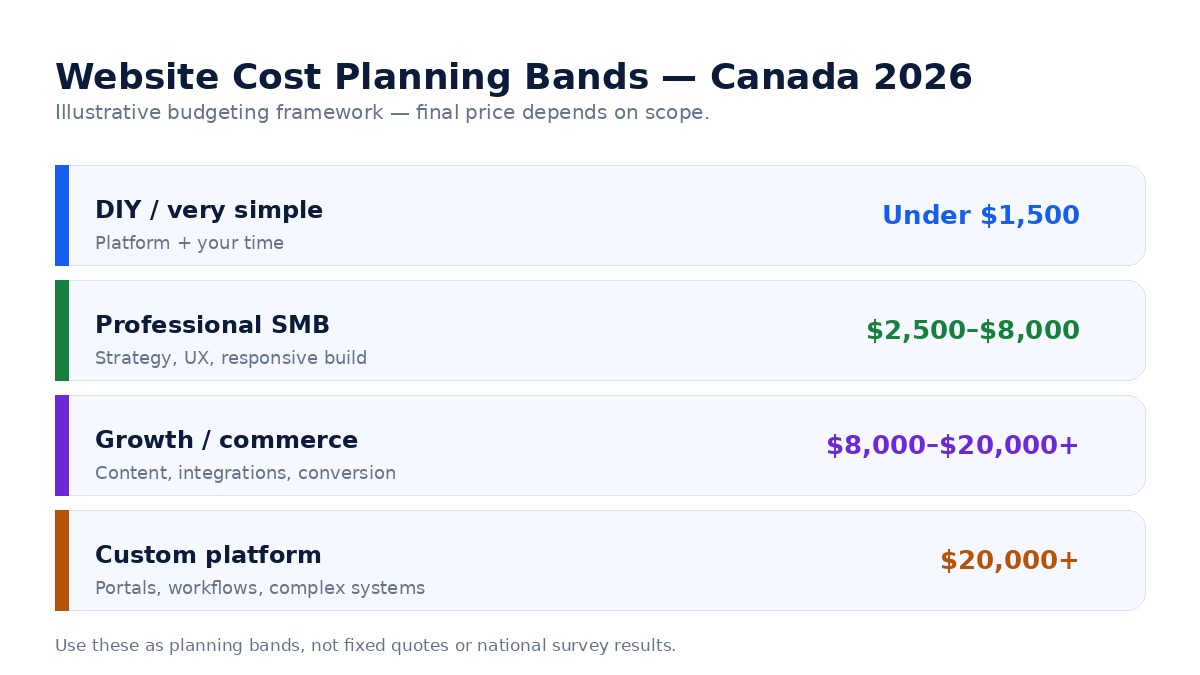
| Website type | Useful planning band (CAD) | Typical situation | Main caution |
|---|---|---|---|
| DIY / very simple | Under $1,500 plus platform/time costs | Very early-stage business or simple online presence | The owner does much of the work and may outgrow the platform |
| Professional SMB website | $2,500–$8,000 | Service businesses needing a credible, responsive lead-generation site | Compare what is actually included rather than the headline price |
| Growth / eCommerce / advanced marketing | $8,000–$20,000+ | More content, custom UX, commerce, booking, integrations or SEO depth | Complexity can rise quickly as systems are connected |
| Custom portal / platform | $20,000+ | Customer portals, custom workflows, data-heavy or application-like experiences | This is closer to software development than a brochure website |
These are planning bands, not fixed Canadian market prices
Actual pricing should come from a defined scope. A business should not assume that every project in a category belongs at the middle of the range, nor should it treat these bands as a quote from HiTechConsultancy.
Why can one website cost $2,500 and another cost $20,000?
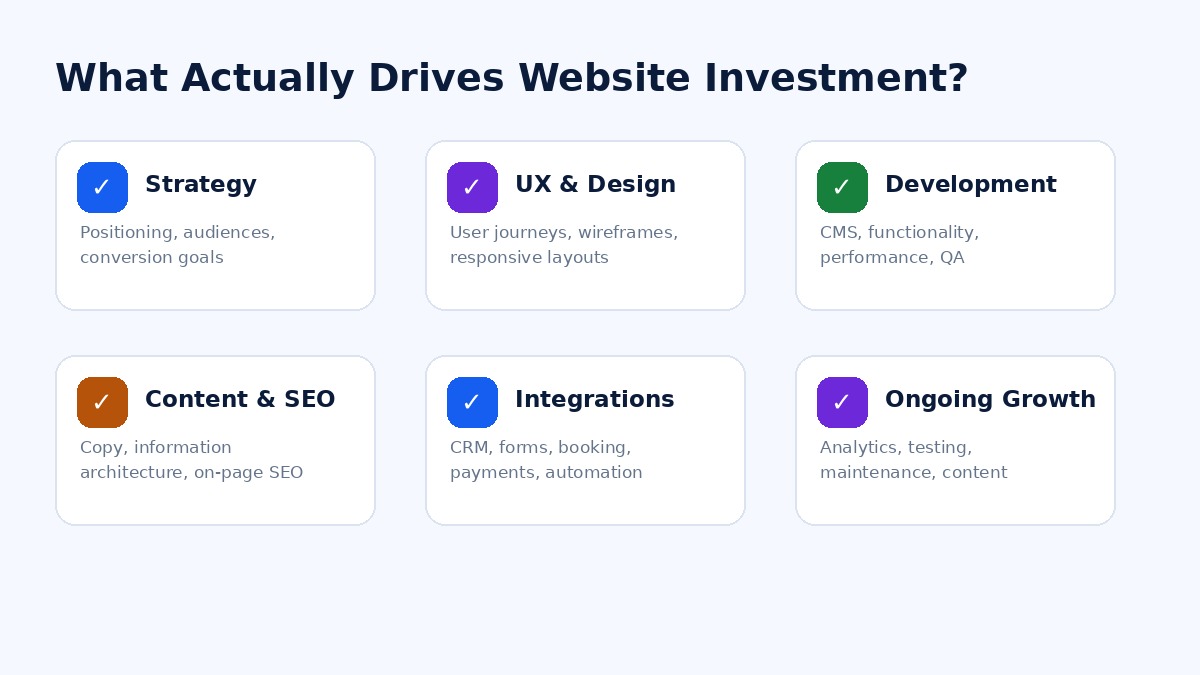
The visible pages are only one part of the work. The deeper cost usually comes from the number and difficulty of decisions that have to be made before the site can reliably do its job.
Strategy
Who is the site for? What services matter most? What should a visitor do next? What objections need to be answered?
UX and design
Information architecture, mobile behaviour, page hierarchy, wireframes, visual design, accessibility and conversion flow.
Development
Frontend, CMS, forms, reusable components, functionality, performance, security configuration and responsive behaviour.
Content
Copywriting, service pages, case studies, FAQs, imagery, legal content and content migration from an older site.
SEO foundations
Search intent, headings, titles, metadata, internal linking, schema, indexability, redirects and local SEO considerations.
Integrations
CRM, Odoo, booking systems, payments, telecom, analytics, chatbots, email and automation workflows.
Quality assurance
Mobile, desktop, browsers, forms, links, performance, accessibility basics, analytics and launch testing.
Project management
Discovery, milestones, feedback, approvals, scope control, content collection and launch coordination.
A strong website proposal should therefore explain the project in terms of outcomes, deliverables and assumptions. If two proposals have very different prices, compare the scope line by line before deciding that one is simply cheaper.
How much should a 5-page website cost in Canada?
A five-page website is often used as a shorthand for a small business project. A typical structure might include Home, About, Services, Contact and one additional page. But “five pages” still does not define the actual effort.
Five pages can be relatively simple if the business already has strong copy, brand assets and a clear structure. The same five pages can require much more work if the agency needs to develop positioning, write content, restructure services, create original visuals, integrate lead capture and build stronger SEO foundations.
Business insight: page count is a weak pricing metric
One well-designed service page with original content, conversion logic, forms, tracking and integrations can require more work than ten basic template pages. Ask what the page needs to achieve, not only how many pages are being delivered.
DIY vs freelancer vs agency: which route makes sense?
DIY website builders
DIY platforms can be useful when the business is new, requirements are simple, budget is genuinely constrained and the owner is prepared to invest time. The monthly platform fee may be low, but the business should still value the time required to learn the system, write the content, design the pages and maintain them.
The limitation usually appears when the website becomes a serious acquisition channel. The business may then need stronger SEO architecture, better conversion design, integrations, more custom functionality or professional content.
Freelancer
A capable freelancer can be an excellent fit for a focused project. The business often receives direct access to the person doing the work and may achieve strong value with less agency overhead.
The risk is that one person may be responsible for strategy, copy, design, development, SEO, QA and project management. That can work well with the right individual, but buyers should verify which capabilities are truly included.
Agency or multidisciplinary team
An agency usually becomes more valuable when the website requires several disciplines at once: positioning, UX, development, SEO, analytics, integrations, conversion optimisation and ongoing support.
The higher fee should correspond to broader capability, stronger process and lower execution risk. Paying an agency price for a template-level build is poor value; paying more for a project that genuinely requires deeper strategy and integration can be commercially rational.
What should be included in a professional Canadian SMB website?
The exact scope varies, but a serious website project should discuss most of the following areas before launch:
- Discovery: business goals, audiences, services, competitors and priority conversion actions.
- Responsive design: the website must work properly on phones, tablets and desktop screens.
- Clear CTAs: calls, forms, booking or other next actions should be easy to understand.
- Trust signals: reviews, credentials, service information, contact details and useful business proof.
- Technical SEO: crawlability, titles, metadata, headings, canonical structure, sitemap and redirects where needed.
- On-page SEO: content aligned with the actual topics and questions customers search for.
- Local SEO considerations: location/service-area relevance and Google Business Profile alignment where applicable.
- Forms and lead capture: validated forms, clear consent language where required and reliable routing. For businesses handling personal information, the Office of the Privacy Commissioner of Canada provides a privacy guide for businesses.
- Analytics: measurement for important actions such as calls, forms, bookings or purchases.
- Performance: image optimisation, efficient code and avoidance of unnecessarily heavy elements.
- Accessibility basics: labels, contrast, keyboard usability, alt text and readable interfaces.
- Security: HTTPS, sensible form handling, access control and secure management of credentials.
- QA: links, forms, devices, browsers, content, analytics and responsive layouts should be tested before launch.
A proposal that leaves most of these areas undefined may still be appropriate for a very small project, but the buyer should understand what is not included.
A website should connect to the rest of your lead system
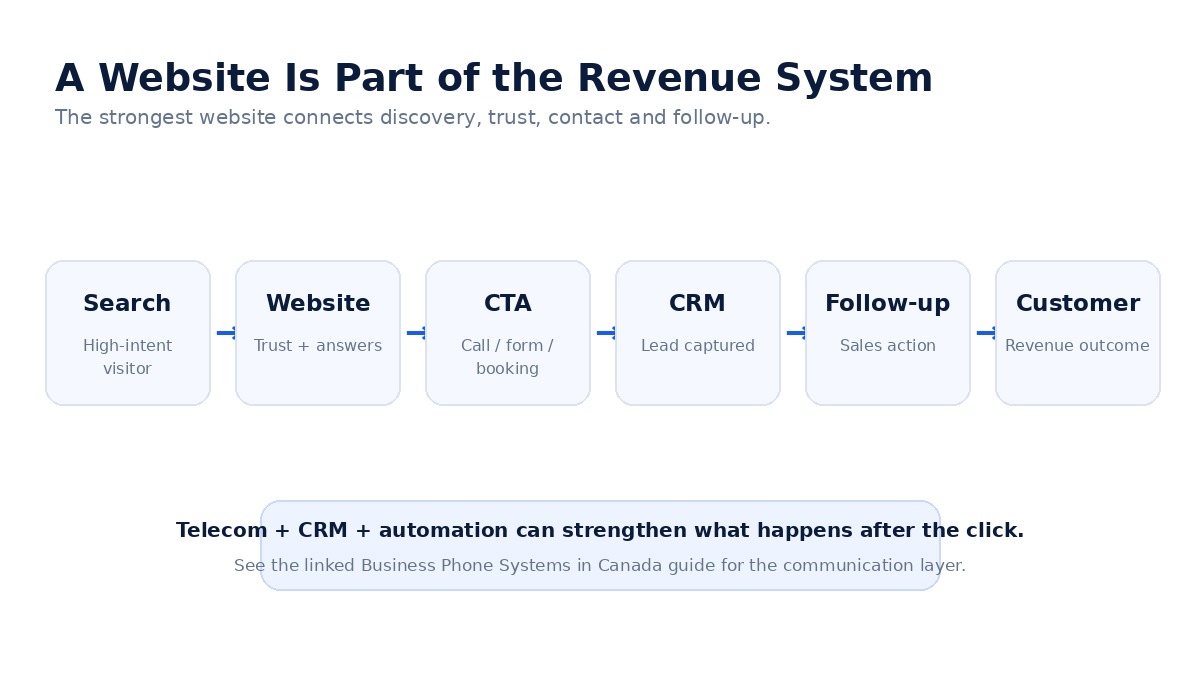
The most commercially useful website is rarely isolated. A customer might discover the business through search, read a service page, call, submit a quote form, enter a CRM, receive follow-up and eventually become a customer.
Search → Website → Trust → CTA → Call/Form → CRM → Follow-up → Customer
This is also where telecom becomes relevant. If your website generates calls but the business phone system cannot route, track or support those enquiries effectively, part of the website investment is being lost after the click.
For a deeper look at that communication layer, read our guide: Business Phone Systems in Canada: What Small Businesses Need in 2026. It explains VoIP, cloud phone systems, call routing, CRM integration, number portability and other considerations for Canadian SMBs.
The same principle applies to CRM and ERP. A website form that simply sends an email may be enough for a very small business. A growing business may need the lead to create a structured CRM record, assign an owner, start a follow-up workflow or connect with Odoo.
What ongoing website costs should Canadian businesses budget for?
The launch price is only the first part of ownership. Ongoing costs can include:
- Domain registration
- Hosting or cloud infrastructure
- Maintenance and software updates
- Backups and monitoring
- Security work
- Content updates
- SEO or local SEO
- Analytics and conversion reporting
- Third-party software subscriptions
- Booking, payment or CRM services
- AI or automation usage where applicable
These costs are not automatically bad. The question is whether each recurring service has a clear business purpose. A monthly website-care plan can be useful if the site changes regularly, contains important integrations or supports meaningful lead generation. It is unnecessary overhead if nothing is being maintained and no measurable service is being delivered.
Red flags when comparing website quotes
“Everything is included” with no scope
If a proposal does not define deliverables, assumptions, content responsibilities, revision limits and integrations, disagreements become more likely later.
Guaranteed SEO rankings
No web developer controls Google's ranking systems. A provider can improve technical quality, content and search strategy, but should not promise a guaranteed organic ranking outcome.
No mobile QA
Canadian SMB customers increasingly interact through phones. A website that is technically responsive but poorly formatted on real mobile screens can still lose enquiries.
No conversion measurement
If the site is intended to generate leads, form submissions, calls, bookings or purchases should be measurable where practical.
No ownership clarity
Businesses should know who controls the domain, hosting account, source code, CMS, analytics and third-party services.
Price before discovery on a complex project
A fixed price can be excellent when the scope is clear. A highly specific fixed quote before the provider understands the requirements can indicate that important assumptions are being hidden.
When should you redesign an existing website instead of starting from scratch?
A redesign does not always require throwing away the entire site. Sometimes the strongest approach is to preserve useful content, URLs and infrastructure while improving the parts that are underperforming.
Consider a redesign when:
- The site looks dated or does not reflect the current business.
- Mobile layouts are weak or broken.
- Navigation makes services difficult to understand.
- Forms are unreliable or enquiries are being missed.
- Important pages are slow.
- SEO structure is poor.
- Calls to action are weak.
- Trust signals are missing.
- The site is difficult for the team to update.
- The business has added services but the website structure has not evolved.
Before rebuilding, preserve anything that is already working: valuable URLs, backlinks, content that receives traffic, analytics history and proven conversion elements.
How should a business think about website ROI?
A website should not be justified with vague statements such as “every business needs a modern website.” The better question is what commercial role the website plays.
A service business might value enquiries. An eCommerce company may measure orders. A professional firm may care about consultation bookings. A B2B company may use the website to improve credibility during a longer sales process.
Simple website value framework
Potential value = qualified leads + conversion improvement + sales support + operational savings + customer-service value − total ownership cost.
This does not produce a guaranteed return. It creates a framework for deciding what is worth investing in and what is merely decorative.
For example, spending more on clearer service pages, stronger mobile conversion or CRM integration can be justified if those improvements solve a verified revenue problem. Spending the same amount on an animation that does not improve understanding or conversion may not be.
What about SEO, AEO and GEO in 2026?
Businesses are increasingly concerned about visibility not only in traditional search results but also in AI-assisted search experiences. The practical response is not to chase a separate set of tricks.
Google Search Central's people-first content guidance continues to emphasise useful, reliable content created for people, while Google's newer guidance says established SEO best practices remain foundational for visibility in generative AI features. For our content strategy, that means:
- Answering important questions clearly.
- Using descriptive headings.
- Providing direct answers where appropriate.
- Adding original business insight instead of rewriting competitors.
- Connecting related topics through useful internal links.
- Using structured data only where it accurately reflects visible content.
- Keeping claims supportable and avoiding invented statistics.
- Creating strong service pages that connect informational content to real business expertise.
The goal is to create content that is understandable and useful to people first, while also being technically accessible to search systems.
Website budget checklist for Canadian SMBs
Before requesting a final quote, answer these questions:
- What is the primary business goal of the website?
- Who are the priority customer groups?
- Which services or products matter most?
- What action should visitors take?
- How many unique page types are actually required?
- Who is responsible for copy and images?
- Does the business need local SEO?
- Does the website need eCommerce, booking or payments?
- Which CRM or ERP systems must connect?
- Does telecom/call handling form part of the lead process?
- What analytics and conversions need to be tracked?
- What must the internal team be able to update?
- What ongoing support will be needed?
- What is the acceptable launch window?
- What first-year budget is commercially realistic?
If these questions are not clear, a short discovery process is usually a better first step than requesting quotes from several providers and comparing only the totals.
Frequently Asked Questions
How much does a small business website cost in Canada in 2026?
Prices vary widely. For planning, a professional Canadian SMB website may fall in the several-thousand-dollar range, while advanced eCommerce and custom platforms can cost substantially more. Scope, content, design, integrations, SEO and testing determine the actual price.
How much does a 5-page website cost in Canada?
Page count alone is not enough to price a project. A simple five-page build may be relatively inexpensive, while a five-page lead-generation site with strategy, original content, custom design, SEO and integrations may require significantly more work.
Should I use a freelancer or an agency?
A freelancer can be excellent for a focused project when one person has the required skills. An agency becomes more valuable when the project needs several disciplines such as strategy, UX, content, development, SEO, analytics and integrations.
Is SEO included in website development?
It depends on the scope. At minimum, a professional build should discuss technical SEO foundations such as titles, headings, crawlability, indexability and site structure. Ongoing SEO, content strategy and local SEO may be separate services.
Do I need a new website or just a redesign?
If the underlying platform and content are still useful, a redesign or targeted optimisation may be sufficient. A full rebuild is more appropriate when the structure, technology, maintainability or functionality is fundamentally limiting the business.
Can my website connect to Odoo or a CRM?
Yes, depending on the platform and available APIs or connectors. Forms, customer records, quotations, bookings, eCommerce and other workflows can often be integrated with CRM or ERP systems when there is a valid business case.
Can the website connect with our phone system?
Potentially. Click-to-call, call tracking, CRM activity and follow-up workflows can be connected where the phone platform and website stack support the required integrations.
Planning a website project in Canada?
Start with the business outcome and required customer journey. HiTechConsultancy can review your current website, identify the highest-value improvements and recommend an appropriate build or redesign scope.
Sources & Further Reading
- Google Search Central — Creating helpful, reliable, people-first content
- Google Search Central — Guide to optimising for generative AI features in Google Search
- Office of the Privacy Commissioner of Canada — Privacy Guide for Businesses
Editorial note: Pricing bands in this article are planning guidance rather than fixed quotations or a national statistical survey. Final website pricing should be based on actual project scope.